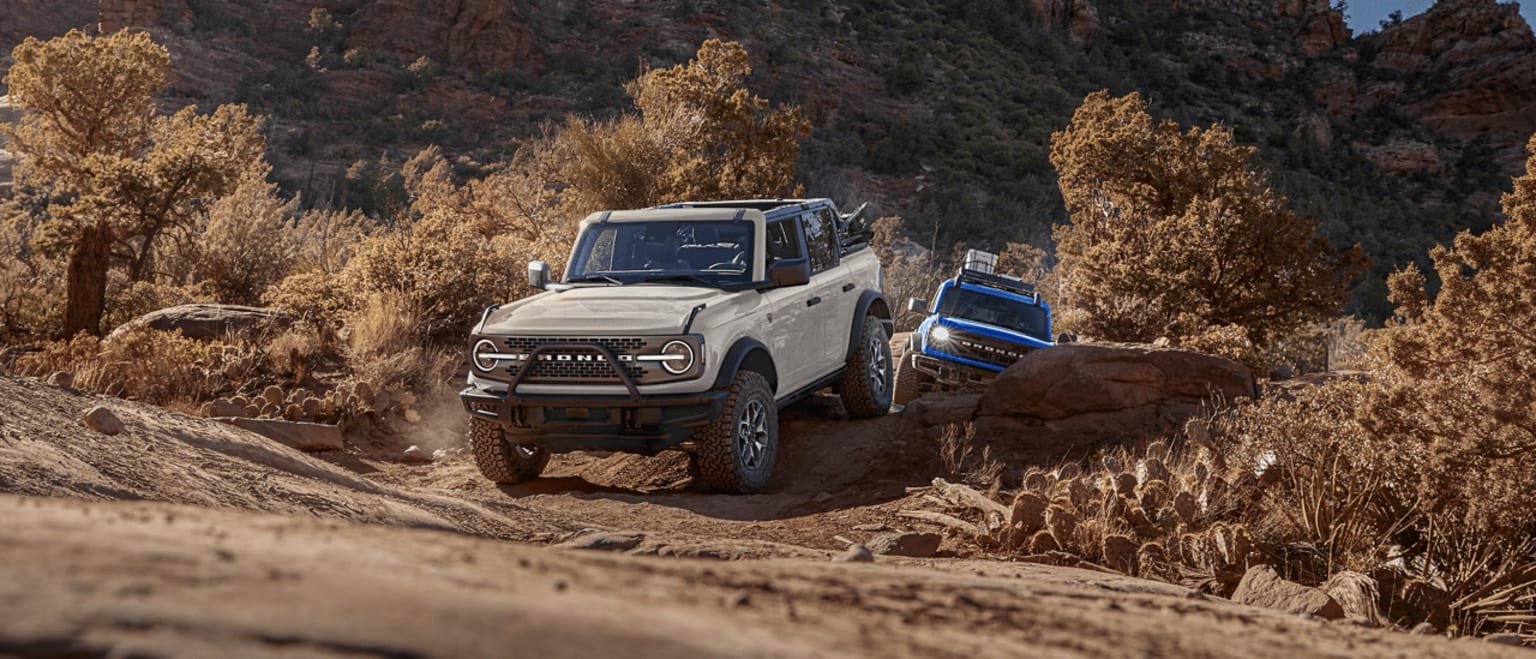
Ford Bronco G.O.A.T. Modes and When to Use Each One
A Bronco can go from weekday traffic to loose sand or rocky terrain without asking you to dig through a complicated settings menu.
That’s the idea behind Ford Bronco G.O.A.T. Modes. Short for “Goes Over Any Type of Terrain,” the system changes multiple vehicle settings to better match the surface underneath you.
But spinning the dial randomly isn’t the point. With the Bronco G.O.A.T. Modes explained, it’s easier to understand what each one changes and when a more aggressive off-road mode is actually useful.
For drivers around Hinesville and Coastal Georgia, some modes may become everyday favorites while others are better saved for weekends when the pavement disappears.
Five Modes Cover Most Everyday Driving
For 2026, Bronco Base, Big Bend, Outer Banks, and Heritage Edition models have five Ford Bronco G.O.A.T. Modes:
Normal: Your default for commuting, highways, errands, and ordinary roads. It keeps the Bronco’s systems balanced for everyday drivability.
Eco: Softens certain responses to prioritize efficiency. Use it when you’re more interested in stretching a tank than sharpening acceleration.
Sport: Makes the Bronco feel more responsive for on-road driving. It’s the G.O.A.T. Mode on a Bronco to choose when you want a livelier throttle and a more energetic driving feel.
Slippery: Designed for reduced-traction surfaces. Around South Georgia, this can be especially useful when heavy rain leaves pavement slick.
Sand: Helps maintain momentum on loose, sandy terrain where getting bogged down is the bigger concern.
That lineup covers far more than serious trail driving. Several modes are designed specifically to make normal roads easier or more enjoyable.
Badlands, Stroppe, and Raptor Get a Different Seven
The more off-road-focused 2026 Bronco Badlands, Stroppe Edition, and Raptor step up to seven Ford Bronco G.O.A.T. Modes.
They include Normal, Eco, Sport, Slippery, Off-Road, Rock Crawl, and Baja.
Off-Road is the broader trail setting. It’s useful when surfaces get loose, uneven, or unpaved and you need the Bronco’s systems working with the terrain rather than treating it like a normal road.
Rock Crawl is built for slow, technical obstacles where control and traction matter far more than speed.
Baja goes in the opposite direction. It’s intended for higher-speed travel over loose terrain, with vehicle settings calibrated for more aggressive off-road performance.
If you wanted the Bronco G.O.A.T. Modes explained simply, think of Rock Crawl as slow and deliberate, Off-Road as the versatile trail choice, and Baja as the high-energy loose-terrain setting.
The Mode Changes More Than the Throttle
The clever part of Ford Bronco G.O.A.T. Modes is that you aren’t simply selecting a different accelerator map.
The G.O.A.T. Mode Bronco drivers select can change more than throttle response. Depending on the mode, the Terrain Management System can alter powertrain response, transmission behavior, traction and stability controls, four-wheel-drive settings, and steering characteristics.
That means selecting the right mode can change how the entire vehicle responds.
It also explains why an off-road mode shouldn’t be treated like a visual theme on the instrument cluster. Use the setting designed for the conditions you’re actually driving through.
Match the Mode to the Surface, Not the Mood
It’s tempting to leave Sport selected because it feels responsive or jump straight into an off-road setting because the road looks rough, but Ford Bronco G.O.A.T. Modes work best when you match the setting to the conditions rather than the mood.
A better strategy is simpler.
Use Normal when conditions are normal. Choose Slippery when traction drops. Use Eco when efficiency matters. Save the terrain-specific settings for the surfaces they were designed to handle.
Learning when to choose each G.O.A.T. Mode on a Bronco is ultimately more useful than memorizing every name.
And remember that trim matters. A Big Bend and a Badlands don’t have identical Ford Bronco G.O.A.T. Modes, so check the actual Bronco you’re driving before assuming a particular setting is available.
Try the Modes Before You Pick the Trim
The number of drive modes is one more reason to think about how adventurous you realistically plan to get.
If most of your driving stays on pavement with occasional sand or loose surfaces, the five-mode system may already cover everything you need. If rocky trails and more technical terrain are part of the plan, the seven-mode Badlands, Stroppe Edition, or Raptor lineup gives you more specialized tools.
Explore our current Bronco inventory at J.C. Lewis Hinesville and compare the Terrain Management System across available trims. Our team can help you look beyond the mode count and choose the Bronco hardware that fits where you actually drive.
Ford Bronco G.O.A.T. Modes are clever technology, but the best mode is still the one that matches the ground beneath your tires.
Frequently Asked Questions
Still have questions about how each G.O.A.T. Mode Bronco option works? Here’s a quick look at the drive modes, how to use them, and which ones are available by model.
How do you use Bronco Sport G.O.A.T. Modes?
On a 2026 Bronco Sport, rotate the G.O.A.T. Mode controller on the center console once to bring up the drive-mode menu, then rotate it again to select and engage the mode you want.
What are the G.O.A.T. Modes on Bronco?
The available Ford Bronco G.O.A.T. Modes depend on trim. Base, Big Bend, Outer Banks, and Heritage Edition get Normal, Eco, Sport, Slippery, and Sand. Badlands, Stroppe Edition, and Raptor get Normal, Eco, Sport, Slippery, Off-Road, Rock Crawl, and Baja.
How many G.O.A.T. Modes are in a Bronco?
A 2026 Bronco has either five or seven G.O.A.T. Modes depending on trim. The more off-road-focused Badlands, Stroppe Edition, and Raptor receive seven.
What G.O.A.T. Modes are exclusive to Bronco Raptor?
For 2026, none of the seven modes are exclusive to Raptor. Badlands and Stroppe Edition share the same mode names: Normal, Eco, Sport, Slippery, Off-Road, Rock Crawl, and Baja. Raptor’s specialized suspension, drivetrain hardware, and calibrations still give those modes a different performance context.
Can you switch G.O.A.T. Modes while driving a Bronco Sport?
In most situations, yes. Ford allows mode changes while driving or while stopped when conditions permit. The Ford Bronco G.O.A.T. Modes are designed to adapt the vehicle to different driving conditions, but you shouldn’t select an off-road mode while traveling on paved public roads. Switching from Normal to Eco on the highway, for example, is appropriate.